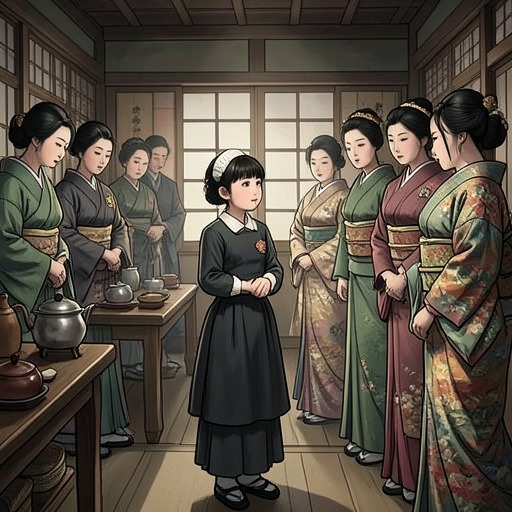
Chiyo’s okiya debt burden
Memoirs of a GeishaChiyo’s okiya debt burden is the economic mechanism that makes her training both a possible route into geisha work and an obligation to the household that controls her. She learns that the amount includes not only the cost of the kimono implicated in Hatsumomo’s trick, but also the expense of acquiring her, her meals, lessons, and medical care. The account follows her from an early, frightening discovery that she must repay a price she had not known she owed to a later bargain over her earnings, and finally to an apparent release that leaves the okiya with her profits.
Debt as the Price of Training
Chiyo does not first encounter the system as an abstract rule. Auntie warns her that Hatsumomo’s trick with the kimono has added a cost beyond anything Chiyo has imagined, then explains the larger account: once Chiyo works as a geisha, she will repay the okiya for the kimono and for the continuing expenses of meals, lessons, and medical treatment. Mother keeps the numbers in small books, a quiet domestic practice that records the household’s claim on Chiyo’s future labor.
That claim extends backward to Chiyo’s arrival. Auntie says the okiya charges her even for the money it spent to acquire her. Chiyo had already wondered whether Mr. Tanaka had made money by helping to sell her and Satsu, recalling the conversation between Mr. Tanaka and her father and Mrs. Fidget’s description of the girls as suitable. What she had not imagined was that she herself would be made responsible for repaying the cost. The new knowledge converts her suspicion about the transaction into a personal liability.
The debt also makes training conditional. Auntie tells Chiyo she will not repay it until she has worked as a geisha for a long time, and that she will never do so if she fails. Running away could cause Mother to see her as a bad investment and stop paying for lessons; without training, Chiyo cannot become a geisha and earn against the account. The system thus binds the means of repayment to the very household debt that makes repayment necessary: Chiyo must remain, learn, and succeed within the arrangement that has priced her future.
An Investment Negotiated in Advance
When Mother considers whether Mameha should take Chiyo as her younger sister, she treats the arrangement in explicitly financial terms. Chiyo’s debts, Mother says, are likely to grow before they diminish, and Mameha’s fees would add to the cost because a geisha of Mameha’s standing takes a larger share of her younger sister’s earnings than an ordinary older sister would. The decision about who will guide Chiyo is therefore also a decision about how much of her future income the okiya will have to commit and how that expense may be recovered.
Mother proposes paying Mameha only half the usual share immediately, then offering the balance she would ordinarily have received, plus an additional thirty percent, if Chiyo repays her debts by the age of twenty. The offer turns an uncertain future into a wager: Mameha would accept reduced payment at first in exchange for a larger return if her judgment of Chiyo proves right. The bargain also shows that Chiyo’s anticipated success has value to more than one party. Her training can increase her earning power, but the money is already being allocated among the household and the person who will sponsor her development.
The Mizuage and the Disappearance of the Balance
After Chiyo’s mizuage, the accounting changes through Mother’s decision to adopt her. The fee from the mizuage is enough to repay all the debts Chiyo owes the okiya. Mother adopts her the following week, and once Chiyo becomes the okiya’s daughter, her debts cease to exist because the household absorbs them. In formal terms, the old balance is settled; in practical terms, the settlement is inseparable from a transfer of status and income.
Chiyo’s name changes first to Sayuri and, with the adoption, to Nitta Sayuri. The change makes plain that the debt does not simply end in personal independence. The fee that could otherwise have partly fallen into Sayuri’s hands belongs to the okiya, and Mother’s adoption ensures that the household receives it. The okiya takes on the debt while claiming all Sayuri’s profits, not just the proceeds of the mizuage but her earnings thereafter. The account is erased by absorbing Sayuri more completely into the institution that kept it.
Patronage and the Wider Economy of the Okiya
The General’s later danna arrangement illustrates how the household’s financial system continues through patronage. He covers expenses ordinarily associated with a patron, including Sayuri’s lessons, annual registration fee, and medical costs. These payments matter to Mother and the okiya even though Sayuri sees little change in her own daily life: she still makes her nightly rounds, and the expected dance recitals, lavish gifts, and paid leisure do not materialize. The arrangement shows a distinction between support reaching the household’s accounts and visible benefits reaching the geisha herself.
The General’s position as director of military procurement also gives the arrangement practical value beyond routine expenses. When Auntie becomes ill in March 1939 and local doctors cannot help, a call to the General brings an important doctor from the military hospital in Kamigyo Ward, along with medicine that cures her. Regular deliveries of tea, sugar, and increasingly scarce chocolates further supplement the okiya’s resources. Patronage therefore helps sustain both the working geisha and the household’s dependents, while leaving the household in the position of organizing the benefits and bearing their costs.
Wartime scarcity makes that interdependence sharper. During the years Sayuri lives with the Arashino family, she sews parachutes by day and sleeps on futons beside the family’s daughter and grandson in the workshop. Food is so scarce that they eat soybean dregs and bran fried in wheat flour, while warmth comes from compressed leaves, newspapers, and magazines. This is not a direct account of Sayuri’s okiya debt, but it clarifies the conditions under which household resources and labor acquire their value: training costs, medical care, and patron deliveries belong to a larger economy of care and survival, vulnerable to shortages and war.
Objects, Earnings, and Control
The account’s financial logic is framed by objects that are costly because they also make status visible. Hatsumomo’s obi requires cords, clasps, and padding, while her brocade kimono and plum-colored obi appear to Chiyo to represent a year’s wages for a policeman or shopkeeper. The okiya’s storehouse contains lacquered cases crowded with kimono, a collection Chiyo judges worth about twice the villages of Yoroido and Senzuru combined; the most expensive robes are kept in a rented vault. These details make the kimono debt more than a bookkeeping entry: clothing is both a tool of the profession and capital held within the household.
Later, when Sayuri moves into Hatsumomo’s room, the few possessions she carries reveal how much the material economy has changed. Cosmetics and permanents have been banned as luxuries, and lavish gifts are rare; her belongings include scrolls, inkstones, bowls, books, magazines, and a sterling-silver stereoscopic viewer given by the Kabuki actor Onoe Yoegoro XVII. The contrast between the earlier storehouse of expensive robes and the few objects Sayuri has accumulated during wartime underscores how quickly wealth and scarcity can change the meaning of possessions. Across these changes, the debt system’s central fact remains: the okiya finances the conditions under which a geisha can work, but its power to count, collect, and redirect earnings keeps the promise of repayment closely tied to dependence.